You have shortlisted several 5G RedCap suppliers. Their specifications look similar, and the prices are within range. So how do you decide which manufacturer to trust with your order?
A competitive quotation can get a supplier onto your shortlist. It cannot tell you whether the product will work on your customer’s network, whether the approved configuration will carry through to production, or how a delivery problem will be handled.
For distributors, system integrators, and device brands sourcing industrial 5G RedCap routers, those are the questions that matter before a purchase order is placed.
The most useful supplier evaluation starts with the product and then follows the order through the factory: technical requirements, production equipment, assembly, inspection, customization, and delivery.
Here is what to check—and where HoweVis’s manufacturing experience and production capabilities fit into that evaluation.
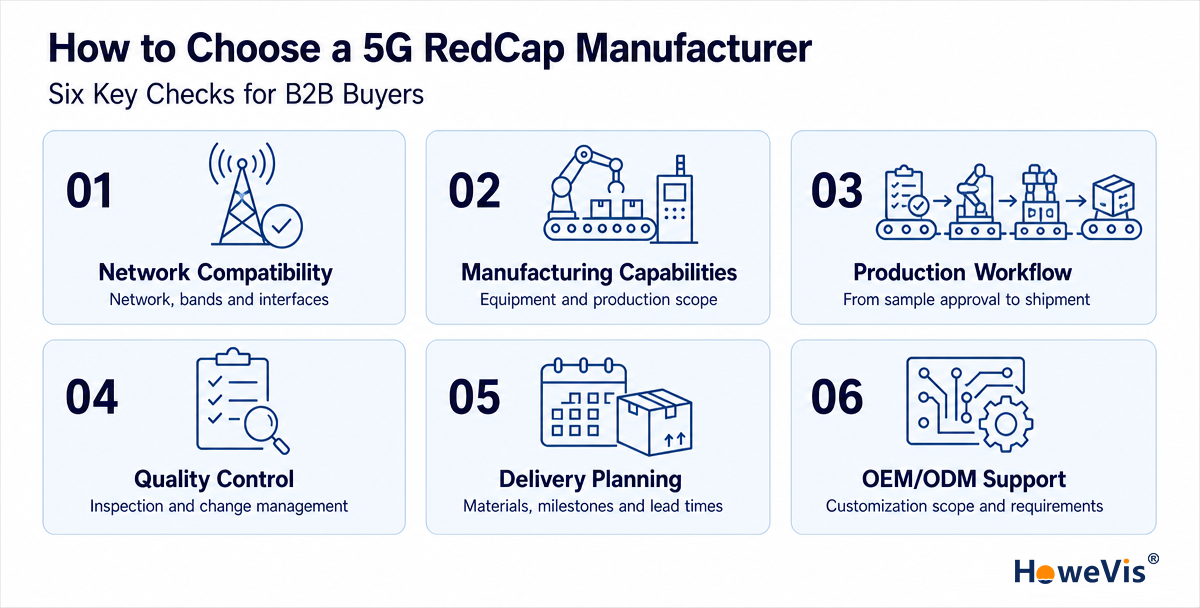
Confirm Network and Product Compatibility Before Comparing Factories
There is little value in auditing a production line if the proposed router does not meet your deployment requirements.
Start with a model-specific discussion. Give the supplier your target country, intended operator, application, and required interfaces. Ask for documentation for the exact configuration being quoted, rather than relying on a general product-family brochure.
| Evaluation Area | What to Confirm |
|---|---|
| Network compatibility | Support for the intended operator and deployment environment |
| Frequency bands | The band list for the exact model and module configuration |
| Physical interfaces | Required Ethernet, serial, I/O, and other connections |
| Installation | Power input, enclosure, dimensions, and mounting requirements |
| Software | Required management, security, and integration functions |
| Compliance | Applicable documents for the product and destination market |
Separate what is available on a standard model from what needs customization. An interface shown on one product does not necessarily come with every model in the range.
For a HoweVis inquiry, this requirements list provides a practical starting point. It allows the discussion to focus on a suitable configuration and the questions that need sample testing before a bulk order.
Look Beyond the Brochure: Check the Manufacturing Equipment
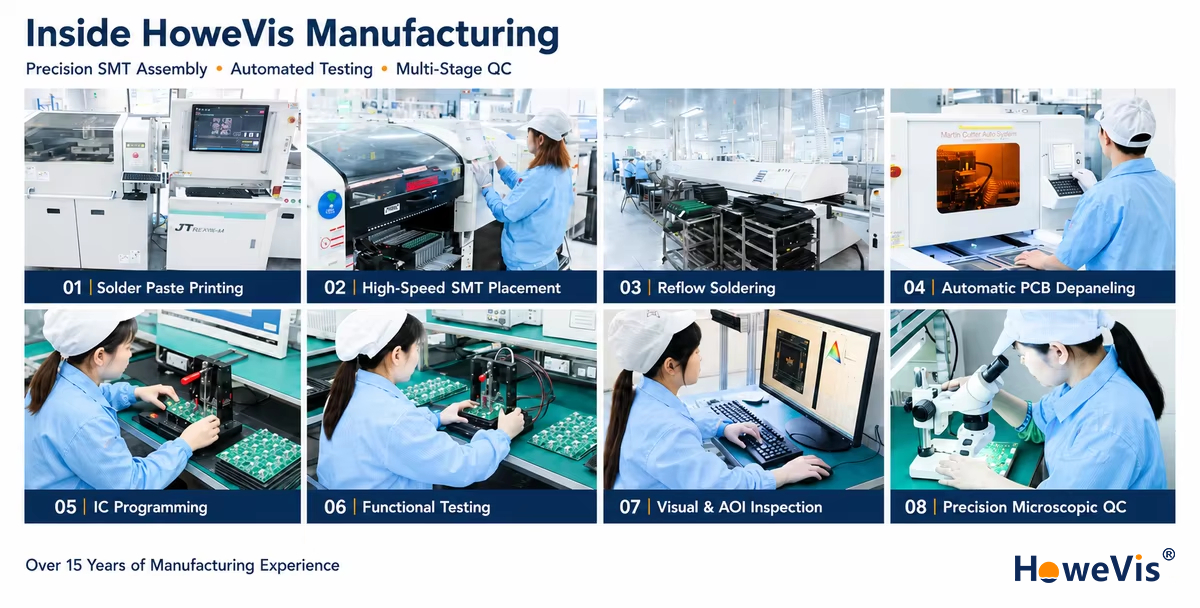
“Factory direct” is easy to put on a website. Buyers need a clearer picture of what happens on the production floor.
Ask which manufacturing stages the supplier handles, what equipment is used, and whether any work is assigned to external partners. Factory photographs are useful, but they should show identifiable equipment and actual production activities—not just a building entrance.
HoweVis has over 15 years of production experience. Its manufacturing equipment includes:
| Solder paste printing machines. |
| High-speed SMT placement machines. |
| Reflow soldering equipment. |
| Automatic PCB depaneling machines |
These are concrete points to discuss when evaluating HoweVis as an industrial router manufacturing partner. Buyers can use them to ask more specific questions about the assembly process, the products manufactured on the equipment, and the arrangements for their proposed order.
Equipment alone should not settle the purchasing decision. It needs to be considered alongside process control, inspection, and the factory’s ability to execute the agreed configuration.
Follow the Order from Specification to Shipment
Equipment is one part of manufacturing. A clearly defined project scope is another.
An organized factory should be able to explain how an approved requirement becomes a production order.
Before discussing volume, agree on the reference configuration. This should cover the hardware, firmware, accessories, labels, and packaging that the buyer expects to receive.
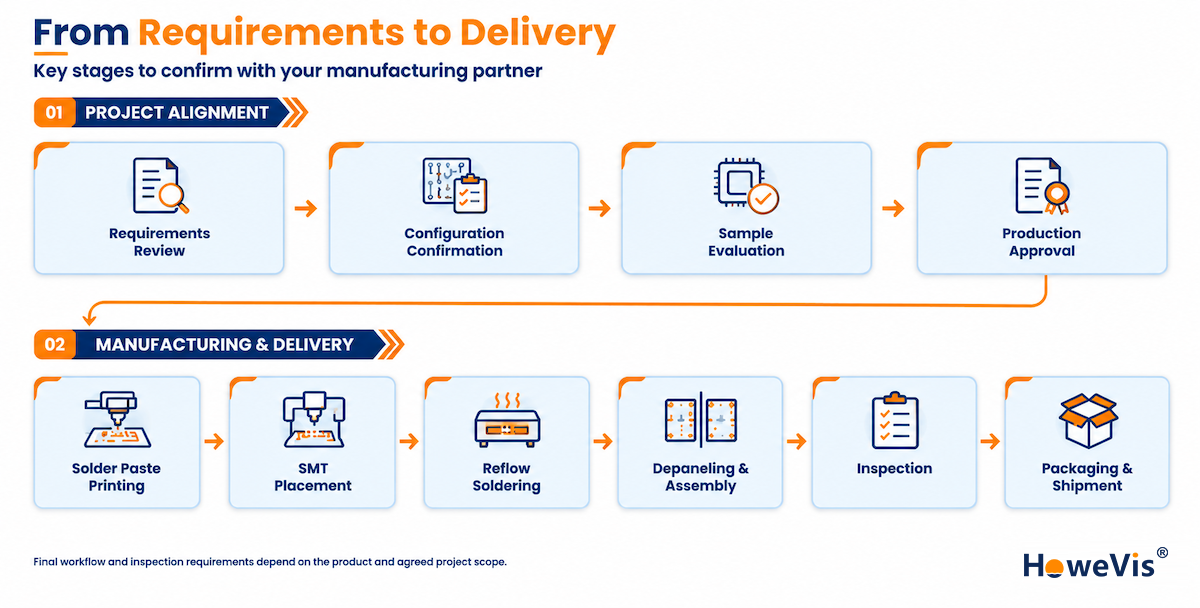
A production discussion can then follow this sequence:
Requirements review → configuration confirmation → sample evaluation → production approval → PCB assembly → product assembly → inspection → packaging and shipment
Ask How Batch Consistency Will Be Checked
A working sample answers one question: can this configuration meet the evaluation requirements?
A bulk order raises another: how will the supplier check that the delivered units match the approved configuration?
Ask for the inspection plan relevant to your product. Depending on the project, the discussion may include interface operation, network connection, firmware configuration, labeling, accessories, and packaging.
The scope matters as much as the test name. For example:
- Is a check performed on every unit or on a sample?
- What are the acceptance criteria?
- What records are retained?
- How are failed units handled?
- Who approves a material or firmware change?
Avoid filling a purchasing specification with impressive test terms that neither side has defined. A short, agreed inspection plan is more useful than a long list of unsupported assurances.
When evaluating HoweVis, request confirmation of the checks applicable to the selected router and order. Any additional testing or reporting requirements should be discussed before the quotation and production schedule are finalized.
5. Evaluate Lead Times by Order Type
“Fast delivery” needs context.
An available standard product, a branded version of an existing router, and a new hardware design do not involve the same preparation. Ask the manufacturer to separate sample availability, customization time, and bulk production lead time.
| Order Type | Main Points to Clarify |
|---|---|
| Standard evaluation sample | Configuration, availability, and dispatch arrangements |
| OEM order | Artwork approval, packaging, settings, and material readiness |
| ODM project | Feasibility review, development, prototyping, and validation |
| Repeat bulk order | Approved version, quantity, materials, and production schedule |
HoweVis places an emphasis on fast delivery. The useful next step is to translate that into an order-specific schedule based on the configuration, quantity, available materials, and customization scope.
State your required delivery date early. Also clarify whether the quoted timeline starts from payment, technical approval, artwork approval, or another agreed milestone.
That detail can prevent a different interpretation of the same delivery promise.
Define What OEM/ODM Means for Your Project
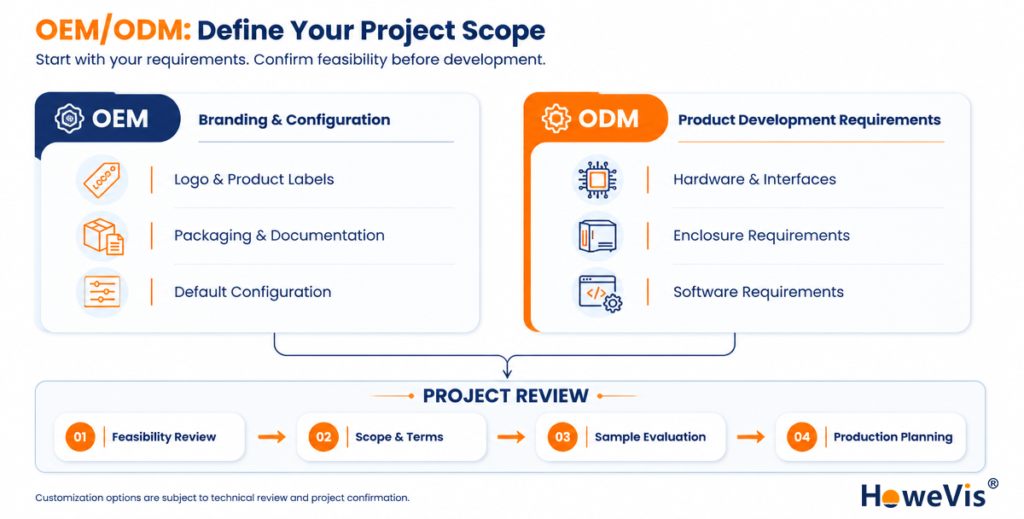
OEM/ODM services can cover very different levels of work. Before comparing offers, describe the changes you actually need.
For one customer, the requirement may be a logo and branded packaging. For another, it may involve interfaces, firmware functions, or a different enclosure.
HoweVis provides OEM/ODM services. The scope of each project should be reviewed rather than assumed from the service label.
| Requested Scope | Questions to Discuss |
|---|---|
| Branding and packaging | Which labels, artwork, documents, and packaging can be changed? |
| Product configuration | Which existing options can meet the application? |
| Software changes | What changes are feasible, and how will they be validated? |
| Hardware or enclosure development | What engineering work, prototypes, and approvals are required? |
| Commercial terms | What MOQ, development charges, ownership terms, and schedules apply? |
Keep the specification and the commercial agreement connected. If a requested change affects development effort, testing, or material sourcing, it should also be reflected in the cost and timeline.
This makes it easier for both parties to distinguish a straightforward branded order from a development project.
7. Use a Short Supplier Checklist Before Placing the Order
Before selecting a 5G RedCap manufacturer, make sure your team can answer these questions:
- Does the exact product configuration match the target market and application?
- Is the supplier’s manufacturing role clear?
- Have the sample and bulk-order specifications been agreed?
- Are inspection requirements and change-handling arrangements documented?
- Is the customization scope defined?
- Does the delivery schedule include its starting conditions?
- Are warranty and technical-support responsibilities clear?
Unanswered questions do not always rule out a supplier. They identify what needs to be resolved before the order proceeds.


Frequently Asked Questions
What information should I send to a 5G RedCap router manufacturer?
Start with the target country, intended operator, application, required interfaces, power input, installation requirements, and estimated quantity. Include any software, branding, or delivery requirements that could affect product selection.
Can I evaluate a sample before placing a bulk order with HoweVis?
Contact HoweVis to confirm sample availability and the appropriate configuration. Agree on what you need to evaluate so that the sample is relevant to the planned purchase.
Does HoweVis provide OEM/ODM services?
Yes. HoweVis provides OEM/ODM services. Share your proposed changes so the team can review the feasible scope, commercial terms, and project schedule.
What is the MOQ, and how long does delivery take?
Request an order-specific quotation. MOQ and delivery arrangements need to be confirmed against the model, quantity, customization requirements, and material availability.
Discuss Your 5G RedCap Project with HoweVis
Choosing a manufacturing partner becomes easier when the discussion moves from broad claims to specific requirements.
HoweVis brings over 15 years of production experience, professional manufacturing equipment, and OEM/ODM services to that discussion. Its equipment includes solder paste printers, high-speed SMT placement machines, reflow soldering equipment, and automatic PCB depaneling machines.
If you are sourcing industrial 5G RedCap routers for distribution, integration, or your own brand, send HoweVis your target market, required configuration, sample quantity, estimated order volume, and expected delivery date.
Contact HoweVis to request product information and discuss sample, customization, and production options for your project.