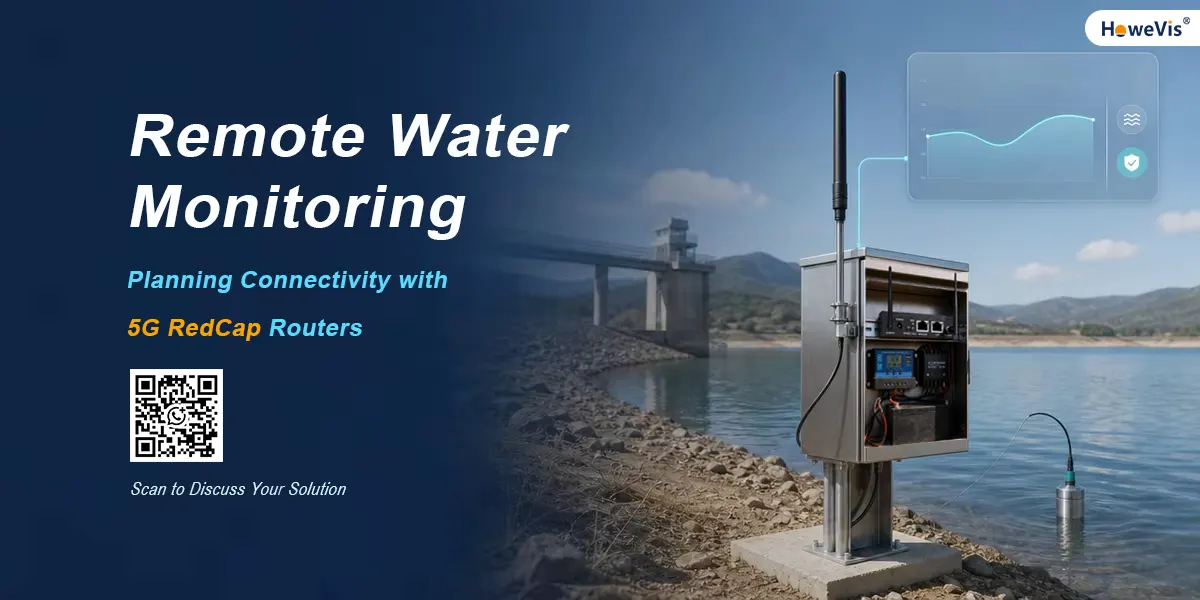
How to evaluate a 5G RedCap router, connect existing instruments, and simplify remote maintenance.
The monitoring station is installed, the instruments are working, and readings are reaching the dashboard. Then a gap appears in the data.
Is it a sensor fault, a power issue, or a lost cellular connection? Can someone diagnose the problem remotely—or does an engineer need to visit the site just to find out?
For water operators and system integrators, this uncertainty is the real connectivity challenge. When a distant station stops reporting, teams need to know whether conditions are normal, equipment has failed, or communication has simply been interrupted.
Choosing a faster router alone does not solve that problem. The goal is reliability: a connection that fits the instruments, reporting requirements, power conditions, and maintenance workflow.
Whether you are considering a 5G RedCap router, an industrial 4G/5G gateway, or a wired connection, start with the site—not the network label.
1. What Makes Remote Water Monitoring Difficult?
Unclear causes of downtime
When measurements stop arriving, the fault could sit anywhere between the instrument and the platform. Without remote visibility, troubleshooting can quickly become a series of site visits.
Specify what engineers must be able to check remotely: device status, network connectivity, configuration, and diagnostic information.
Existing instruments need to stay connected
Water monitoring projects may involve equipment with different interfaces and protocols. Before selecting a gateway, document the instruments, controllers, acquisition devices, and platform requirements.
HoweVis’s HVT-IR25659X industrial gateway page lists RS232 and optional RS485, along with optional Modbus-related functions, MQTT, and Python development support. The required configuration and integration workflow should be confirmed before ordering.
Power and installation constraints
An off-grid monitoring station needs a complete energy budget—not simply a router with a wide input-voltage range.
Include the instruments, acquisition equipment, router, accessories, and operating schedule. Separately define the enclosure, cable entries, antenna position, and maintenance access.
Maintenance becomes harder as sites multiply
A connection that is manageable at one site may become difficult to support across a larger deployment.
Standardized configurations, useful diagnostics, and documented recovery procedures should therefore be part of the design from the beginning.
2. Where Does a 5G RedCap Router Fit?
An industrial 5G RedCap router is an option to evaluate when specifying cellular connectivity for a smart water IoT project. However, its suitability depends on the exact product and installation requirements.
HoweVis lists an industrial 5G RedCap router offering on its website. Request model-specific documentation before assigning it to a particular water monitoring application.
Use these questions to guide the evaluation:
| Requirement | What to confirm |
|---|---|
| Network | Supported frequencies, operator requirements, and deployment region |
| Interfaces | Ethernet, serial connections, and any external acquisition equipment |
| Traffic | Routine measurements, alarms, diagnostics, and multimedia requirements |
| Power | Measured consumption under the intended operating conditions |
| Recovery | Behavior during connection loss and restoration |
| Management | Available diagnostic, configuration, and update functions |
Do not assume that a 5G RedCap router automatically includes analog acquisition, deep-sleep operation, data buffering, or every industrial protocol.
Also keep product families distinct: the specifications of HoweVis’s HVT-IR25659X conventional cellular gateway should not be transferred to a separate RedCap product without confirmation.
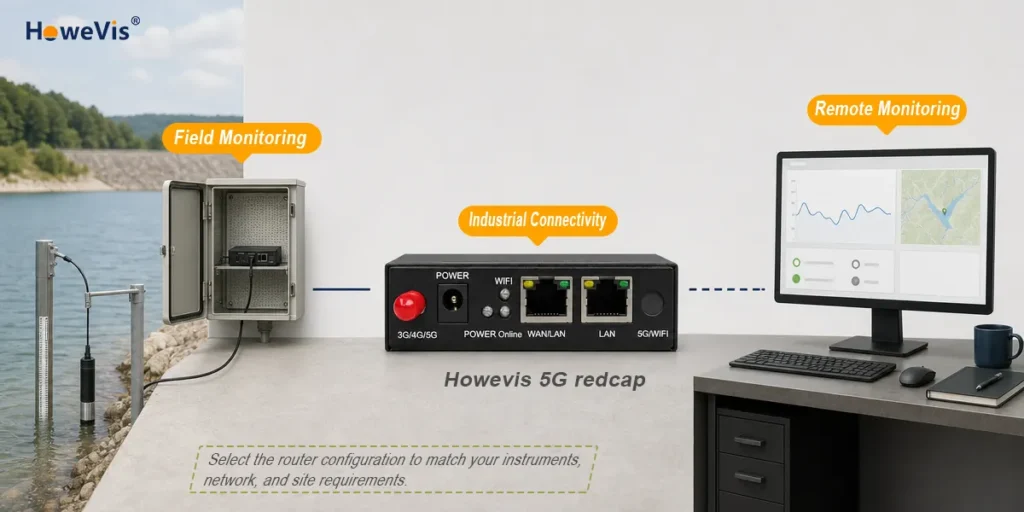
3. Build the Architecture in Three Layers
A clear remote water monitoring architecture separates device access, site networking, and remote backhaul.
Field-device access
Confirm both the physical interface and the communication protocol. Document device addresses, data formats, sampling requirements, and any necessary conversion.
Decide whether acquisition belongs to a PLC, data logger, dedicated module, or verified gateway software.
Site networking
A multi-device pumping station needs a different network from a single-instrument monitoring point.
HoweVis’s managed industrial switch page lists VLAN, QoS, SNMP, SSH, and redundancy protocols. These capabilities can support site-network organization and management, subject to the selected model and configuration.
For compatible powered endpoints, evaluate PoE separately. Check the endpoint requirements, per-port capability, and total power budget rather than assuming every instrument supports PoE.
Remote backhaul
Define how the site reaches the platform, which service is responsible for the connection, and what happens during interruption.
If the project requires LoRaWAN, satellite, or another technology, specify that architecture separately rather than assuming it is included in a cellular router.
4. Test Recovery—not Just Initial Connectivity
A successful first connection is only the beginning.
HoweVis’s HVT-IR25659X product page lists link detection, automatic reconnection, watchdog protection, and optional dual-SIM backup.
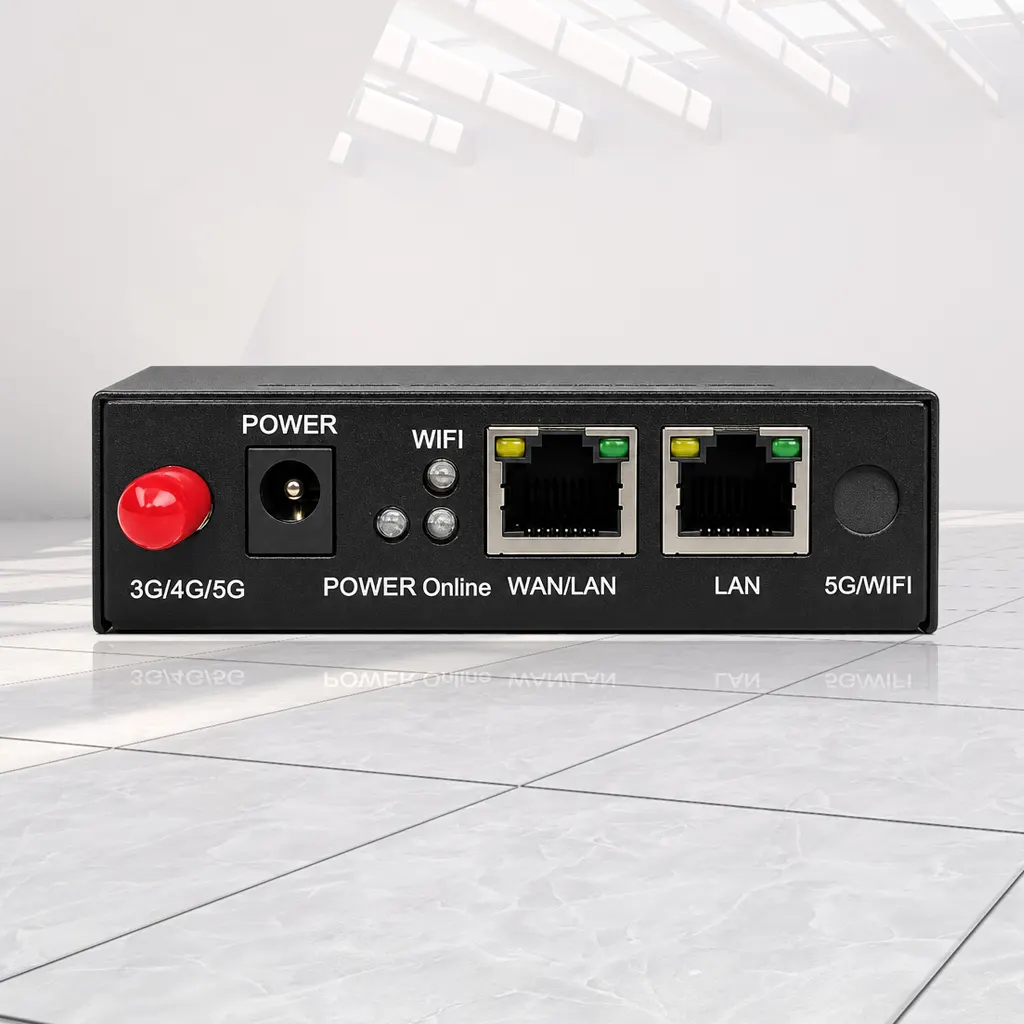
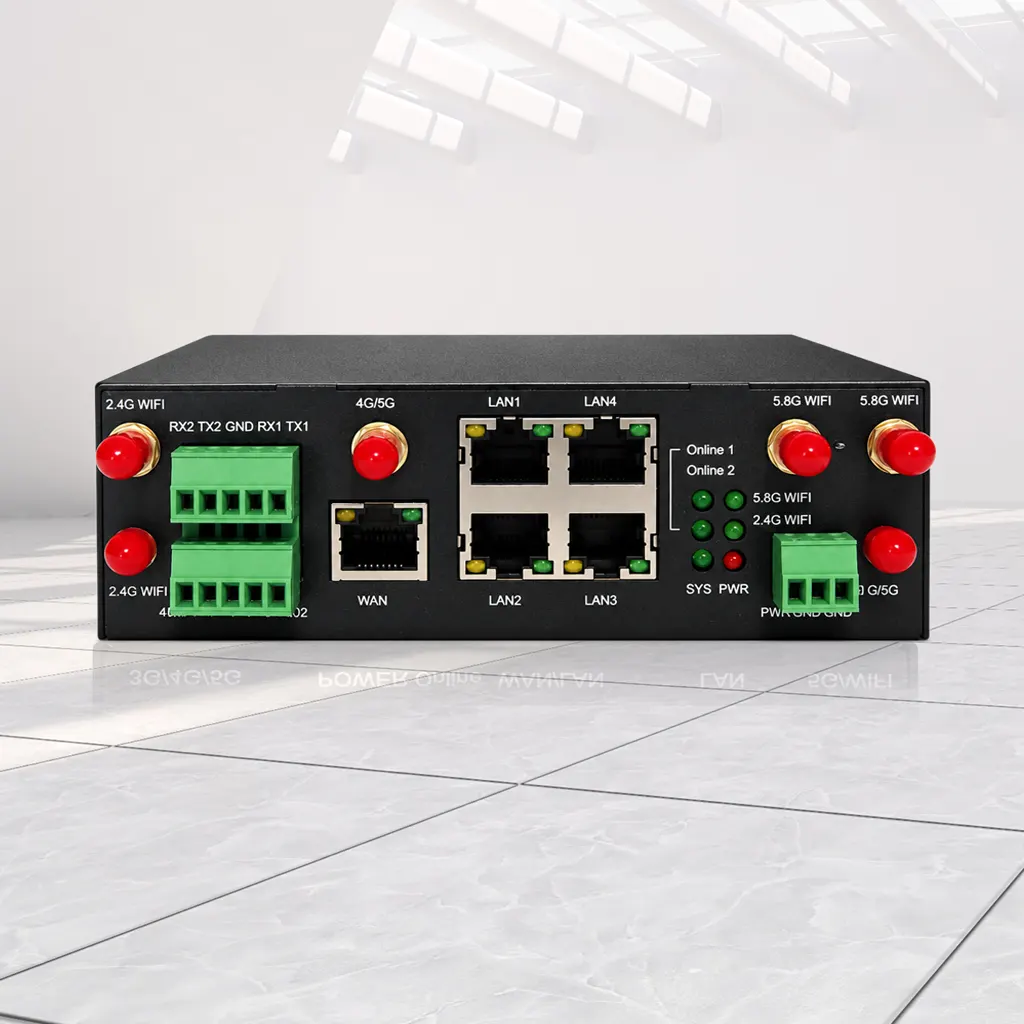
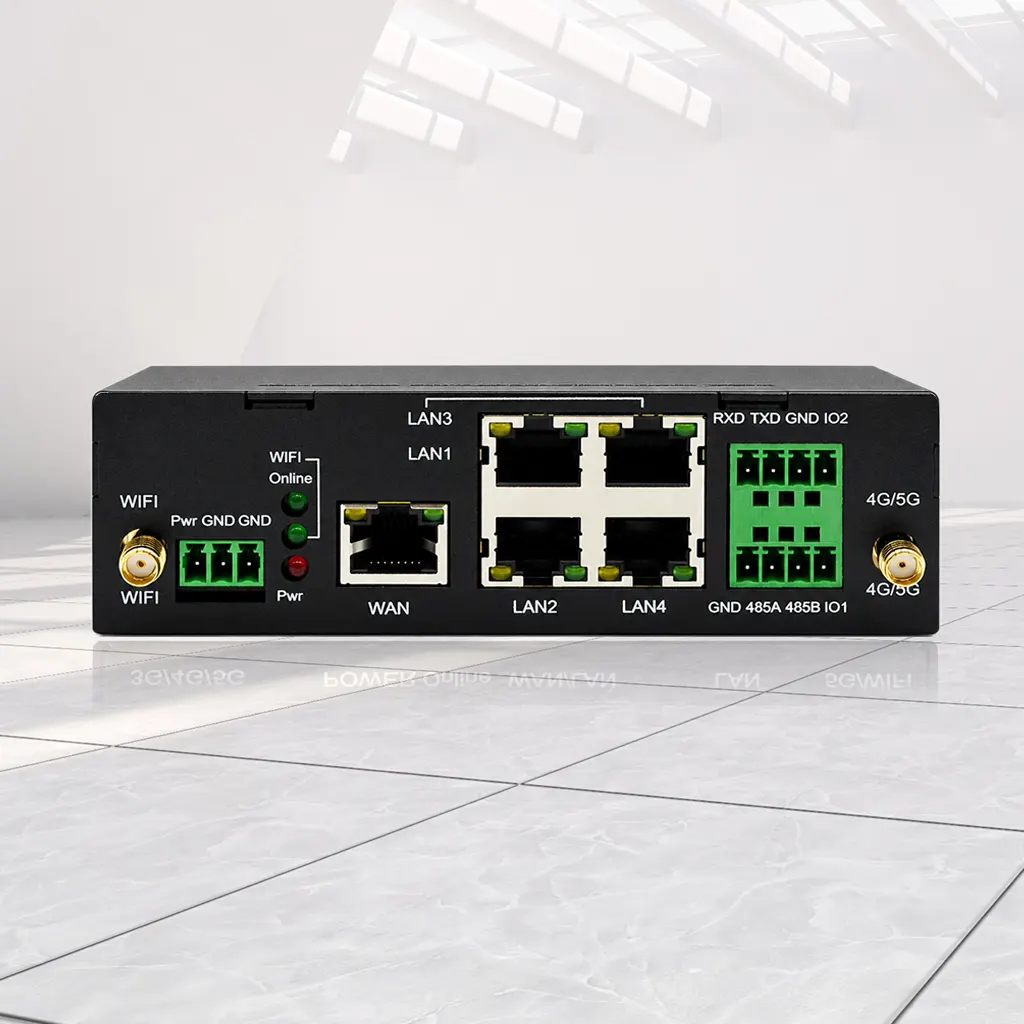
During a pilot, interrupt the connection and observe:
- How quickly the failure is detected.
- What recovery action occurs.
- Whether the application reconnects.
- When valid measurements reach the platform again.
Dual SIM should also be tested. Some HVT-IR25659X variants use one cellular module with two SIM cards; this should not be described as two simultaneously active cellular links.
Data retention is a separate requirement. Identify which component stores measurements during an outage, how much it retains, and how replay is handled. Automatic reconnection alone does not establish a complete buffering and retransmission workflow.
5. Two Practical Water Monitoring Architectures
Remote reservoir or water-quality station
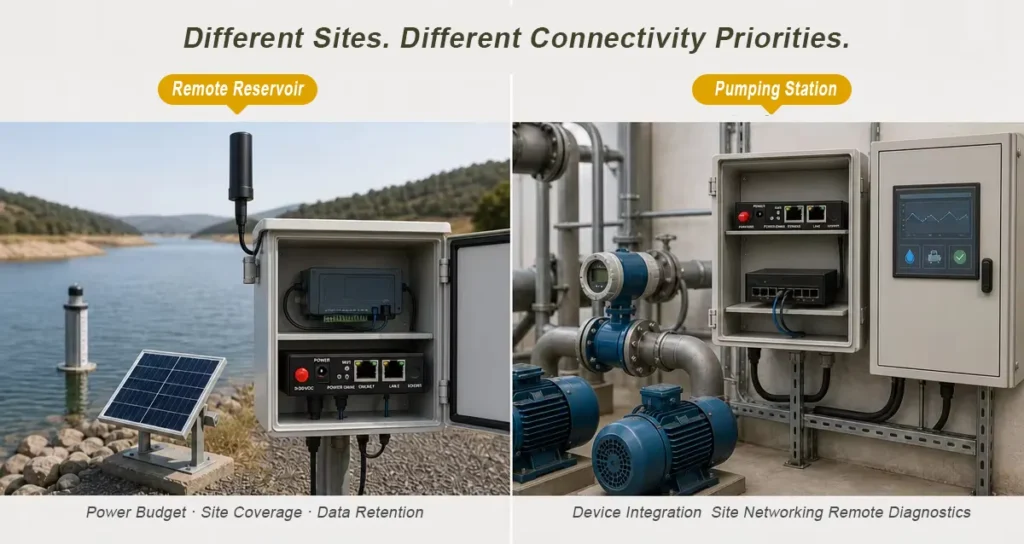
Prioritize instrument compatibility, installed network performance, power consumption, and outage handling.
If evaluating a 5G RedCap router, test the actual configuration with the intended instruments and network service before expanding deployment.
Outdoor protection must also be explicit. For example, the HVT-IR25659X page states an IP30 enclosure, DC 7–36V input, and a −35°C to +75°C operating range. Its enclosure should not be presented as outdoor waterproof protection.
Pumping station with multiple devices
Prioritize network organization, diagnostics, access control, and expansion capacity.
HoweVis offers industrial switching and PoE product options for these networking layers. Its HVT-IR25659X gateway page also lists VPN, firewall, and access-control capabilities, which must be configured around the project’s security requirements.
Where remote control is involved, define authorization, local protection, and behavior during communication loss separately.
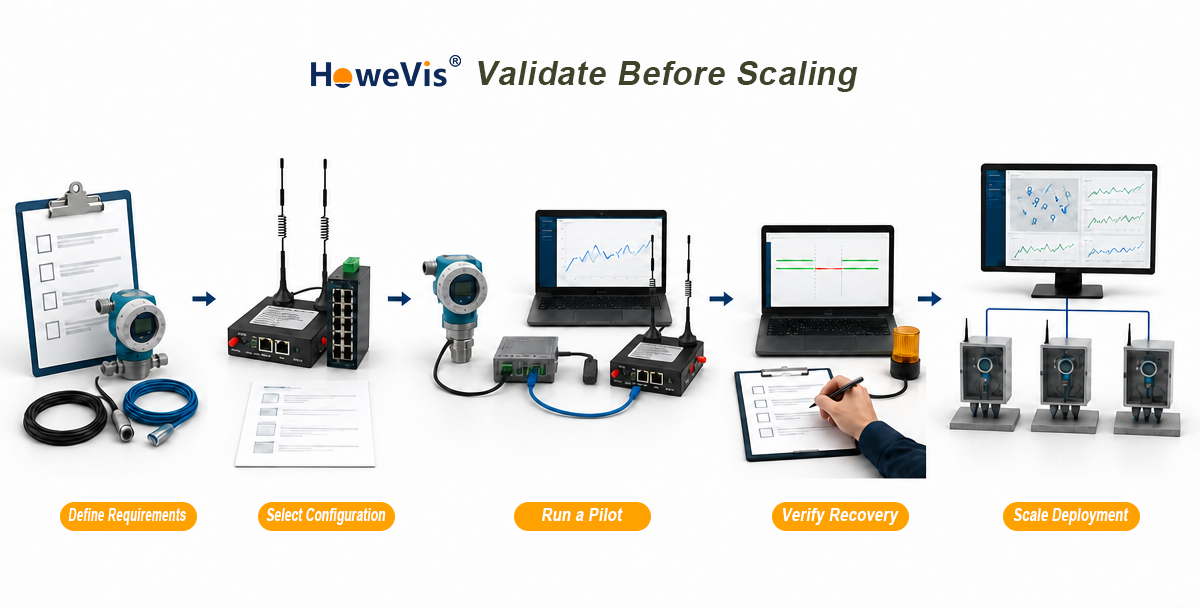
6. Validate Before Scaling
Before committing to a large deployment, agree on measurable acceptance criteria.
| Test area | Evidence required |
|---|---|
| Integration | Correct readings from actual instruments |
| Delivery | Reporting frequency and timing meet requirements |
| Recovery | Demonstrated behavior during network interruption |
| Backup | Verified switching under agreed conditions |
| Retention | Confirmed storage and replay, where required |
| Maintenance | Successful remote diagnosis and configuration |
| Power | Measured consumption and restart behavior |
Compare the complete project cost, including installation, software options, network services, integration, and ongoing maintenance—not just the router price.
Build Around the Project, Not the Product Label
The right connectivity solution makes the site easier to operate, troubleshoot, and expand.
HoweVis’s portfolio includes industrial cellular gateways, a 5G RedCap router offering, industrial switches, PoE products, optical components, and OEM/ODM services.
Planning a remote water monitoring project? Share your site locations, instrument interfaces, reporting intervals, power conditions, and platform requirements with HoweVis. Discuss suitable configurations and sample-testing arrangements, then validate the proposed architecture before scaling.